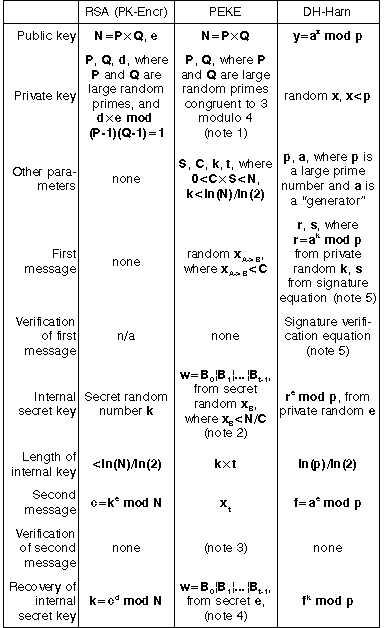
A public key cryptosystem (PKC) is at the heart of the SAKEM procedure. There are at least three possible PKCs, namely
e" for PEKE bears no relation to the symbol number
"e" for DH-Harn). As with most public key cryptosystems, all
computations are made with integer arithmetic, and often with very large
operands. The usual known art of algorithmic number theory is implied.
The symbol
"|" represents concatenation of
k-bit strings, and tacitly specifies a conversion from integer to bit
string. Any of the following symbols should be read as if it was a
one-letter symbol:
xA->B,
xB¦,
alpha,
beta,
mu, and
nu.
a and
b such that
a×P+b×Q=1, and
alpha=((P+1)/4)(t+1) mod (P-1), and
beta=((Q+1)/4)(t+1) mod (Q-1).
x=(xB¦-(xB¦ mod S))×S×C+xA->B×S+(xB¦ mod S),
x0=x2 mod N,
xi+1=xi2 mod N, where
i runs from 0 to
t-1, and
Bi=xi mod 2k, where
i runs from 0 to
t-1.
mu=(xt mod P)alpha mod P,
nu=(xt mod Q)beta mod Q,
e=(b×Q×mu+a×P×nu) mod N,
f=(b×Q×(P-mu)+a×P×nu) mod N,
g=(b×Q×mu+a×P×(Q-nu)) mod N,
h=(b×Q×(P-mu)+a×P×(Q-nu)) mod N,
e,
f,
g, or
h satisfies
xA->B×S=(? mod (S×C))-(? mod S).
x0=e2 mod N,
xi+1=xi2 mod N, where
i runs from 0 to
t-1, and
Bi=xi mod 2k, where
i runs from 0 to
t-1.
The RSA cryptosystem is an alternative available for the PEKE cryptosystem. There may be institutional arguments in favor of the RSA cryptosystem, but technical merits are favourable to the PEKE alternative, notably:
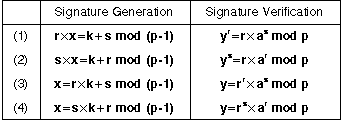
The DH-Harn alternative is based on the difficulty of the discrete logarithm problem rather than the difficulty of factoring large integers as in the PEKE and PK-encr alternatives. Assuming no flaw is found in the mathematics of the Lein Harn improvement to the Diffie-Hellman cryptosystem, a comparative study of the relative merits of the three alternatives when exposed to the diverse attack scenarios could fill a complete book.
[ CONNOTECH home page: http://www.connotech.com/ | SAKEM web page: http://www.connotech.com/sakem.htm | about us | web editorial policy | e-mail to: info@connotech.com ]
CONNOTECH Experts-conseils Inc.
9130 Place de Montgolfier
Montréal, Québec, Canada, H2M 2A1
Tél.: +1-514-385-5691
Fax: +1-514-385-5900