CONNOTECH Experts-conseils Inc.
In considering the patent licensing requirements for an application of the PEKE technology, the facts related in this annex may be considered. For the cryptography expert, most of these facts are elementary, or can be easily inferred from reading the references. For the legal advisor, these facts (validated by an independent expert if need be) may constitute the basis for a legal opinion.
In the field of public key cryptography, the following concepts are defined:
Public key encryption is a process in which a message is encrypted using the public key of the legitimate recipient. Only the legitimate recipient is capable of decrypting the message encrypted in this way.A digital signature is the transformation of a message by a signer using secret information (a private key), this transformation being impossible to achieve without knowledge of this secret information. Any party knowing the signer's public key can verify the digital signature.
The Diffie-Hellman cryptosystem, USA patent document 4,200,770 [2] (see also [1]), offers neither a public key encryption technology nor a digital signature capability. Instead, it allows two parties to establish a secret session key without sharing any prior secret information and without using a third party. There is no recognized generic term for this secret key exchange capability. With the exception of the PEKE technology, no cryptosystem besides Diffie-Hellman offers the secret key exchange capability independently of the public key encryption capability.
The text of the Hellman-Merkle patent, USA patent document 4,218,582 [3], discloses the knapsack cryptosystem [4], [5], and contains claims (notably claims 1 and 6) describing in fairly generic terms the notion of public key encipherment. This patent also contains claims (notably claims 4 and 5) describing in fairly generic terms the notion of digital signatures. The Hellman-Merkle claims do not describe the notion of secret key exchange introduced by the Diffie-Hellman cryptosystem.
The PEKE technology offers neither a public key encryption capability nor a digital signature capability. The services and the protections offered by the PEKE technology are comparable to the Diffie-Hellman cryptosystem.
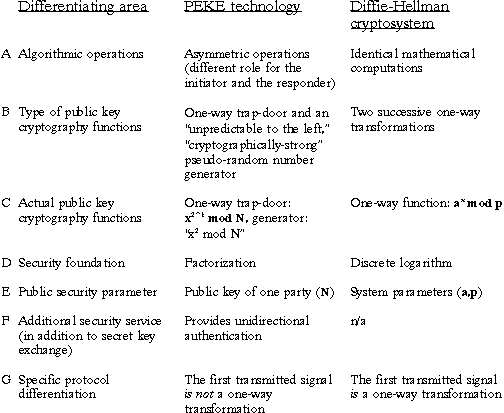
Table: Differences between the PEKE technology and the Diffie-Hellman cryptosystem
There are many differences between the PEKE technology and the Diffie-Hellman cryptosystems in their operation. They are summarized in the table above and explained below:
[1] Diffie, Bailey Whitfield, Hellman, Martin E., New Directions in Cryptography, IEEE Transactions in Information Theory, vol IT-22, 1976, pp 644-654
[2] USA patent document 4,200,770 Hellman, Martin E., Diffie, Bailey Whitfield, Merkle, Ralph C., Cryptographic Apparatus and Method, April 29, 1980 (the Canadian equivalent to this patent is patent number 1,121,480)
[3] USA patent document 4,218,582 Hellman, Martin E., Merkle, Ralph C., Public Key Cryptographic Apparatus and Method, August 19, 1980 (foreign equivalents: Australia 40 418/78, Belgium 871039, Canada 1 128 159, France 78 28474, Germany DE 28 43 583 C2, Italy 1099780, Japan 1,270,888, Spain 474.539, Sweden 78 10478-3, Switzerland 634161, United Kingdom 2 006 580 B)
[4] Merkle, Ralph C., Hellman, Martin E., Hiding information and signatures in trapdoor knapsacks, IEEE Transactions on Information Theory, Vol. 24 (1978), pp 525-534
[5] Odlyzko, A.M., The Rise and Fall of Knapsack Cryptosystems, in Cryptology and Computational Number Theory, C. Pomerance, editor, American Mathematical Society, 1990, pp 75-88
[ Web Map for PEKE:
http://www.connotech.com/pekemap.htm ]
[ CONNOTECH home page:
http://www.connotech.com/
| about us
| web editorial policy | e-mail to:
info@connotech.com ]
CONNOTECH Experts-conseils Inc.
9130 Place de Montgolfier
Montréal, Québec, Canada, H2M 2A1
Tél.: +1-514-385-5691
Fax: +1-514-385-5900