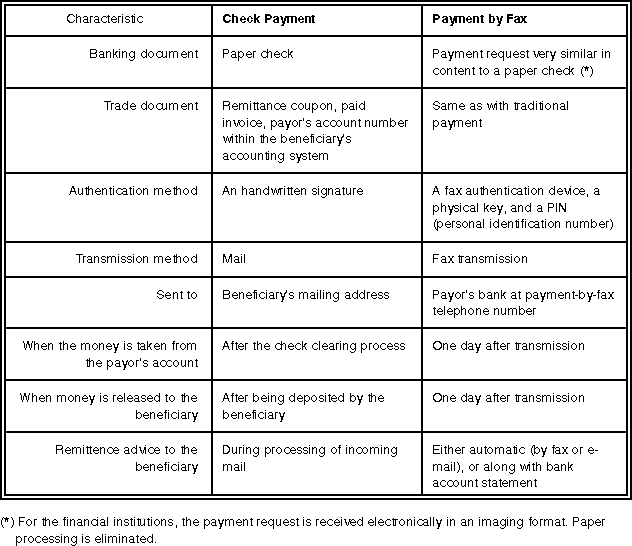
Table 1) Distinctive characteristics of Payment by Fax
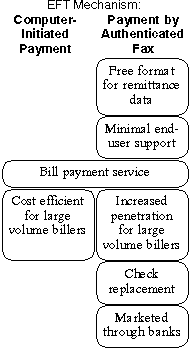
Figure 1) Positioning of Payment Mechanisms
Figure 2) Traditional Check Processing
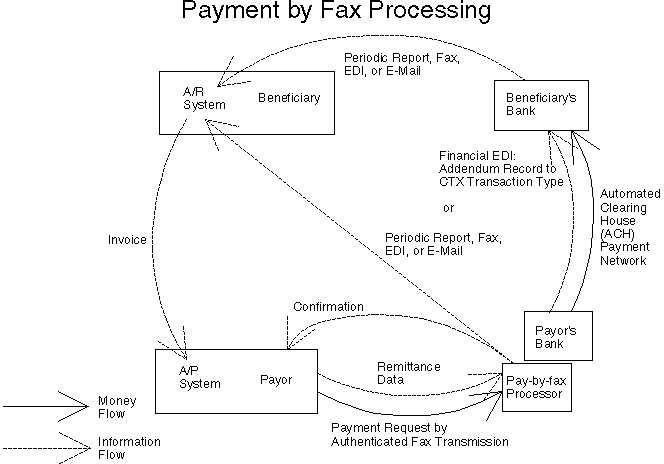
Figure 3) Payment by Fax Processing
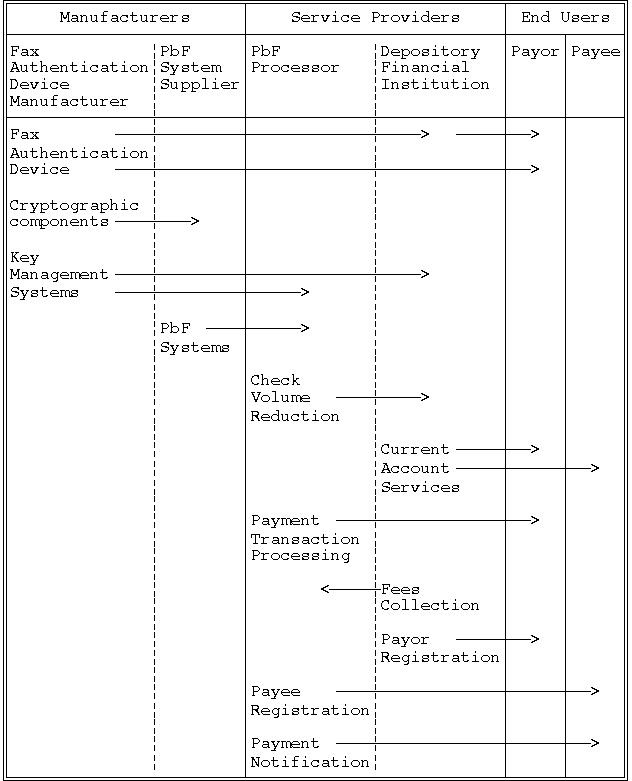
Table 2) Who sells what to whom for payment by fax?
Figure 4) Technological Environment for Payment by Fax Processors
Figure 5) PbF Processing by the Payor's Bank
Figure 6) PbF Processing Outsourced by an ACH Origination Capable Bank
Figure 7) Outsourcing of ACH Origination and PbF Processing
Figure 8) Processing Steps for Payment by Fax
Table 3) Payment Advice Delivery Methods
CONNOTECH proposes payment by authenticated facsimile transmission ("payment by fax") to expand the payment options offered by the U.S. banking industry. This novel payment mechanism is like payment by check for the payor. For the other parties involved in the transaction, it is a form of electronic funds transfers (EFT). CONNOTECH has filed a patent application to the U.S. Patent and Trademark Office to cover this payment method.
Payment by fax requires two supporting technologies: 1) secure facsimile transmission (embedded in a fax authentication device) and 2) computerized document imaging systems. CONNOTECH is developing the required hardware, software and systems to position itself as the equipment manufacturer for payment by fax.
The primary application area for payment by fax is the Automated Clearing House ("ACH") payment network in the United States. Payment requests initiated by authenticated fax messages are processed to enter the ACH payment network as Corporate Trade Exchange ("CTX") transactions, the electronic alternative to paper checks for business payments.
The reader should be aware of the contemporary U.S. payment system characteristics (see note 1). This document describes payment by fax in the context of existing payment methods. The purpose of this document is to promote the concept of payment by fax by explaining its key characteristics in relation to the current situation.
Payment by fax represents a business opportunity to financial institutions, outsourcing organizations (third party processors), and to network service providers. Please contact CONNOTECH for more information.
CONNOTECH proposes a payment mechanism using authenticated fax transmission. It is a check replacement technology, allowing small and medium business managers to send authenticated payment requests to their bank instead of mailing paper checks to the payment beneficiaries.
This payment method is a highly secure process based on three security factors:
For the payor, there are more similarities than differences between traditional payment by paper check and payment by fax. In the business environment, the usual payment cycle includes the following steps:
With the payment by fax method, the invoicing step is unmodified and the payment issue step is slightly modified from the traditional check:
Table 1 summarizes the differences between checks and payment by fax.
For the other parties involved in the payment process, including banks, payment by fax looks like replacing paper checks by electronic funds transfer (EFT). Money is deposited directly into the beneficiary's account at his bank. The beneficiary also receives a "payment advice," a message that contains remittance data and a bank confirmation of the payment amount and date. This payment advice may be received as a periodic statement, a fax transmission, or an electronic mail message. If the electronic mail message adheres to an industry standard format, it is called an EDI message.
Payment by fax offered by CONNOTECH is a unique improvement over payment by check, however there are other existing and emerging improvements:
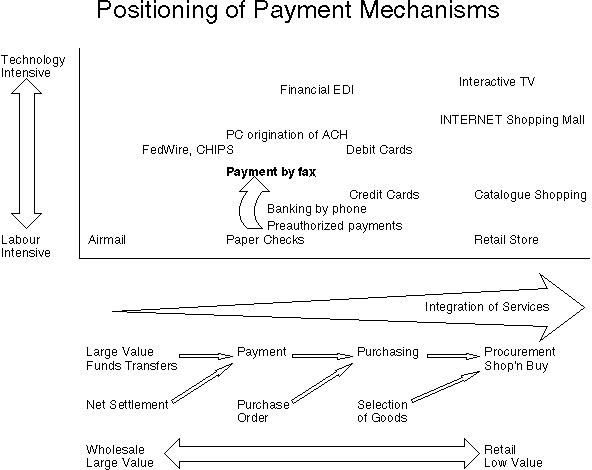
In the following sections, computer-initiated payment refers equally to PC origination of ACH and financial EDI (to the extent it can meet the requirements of small and medium businesses). Computer-initiated payment is currently being introduced by a number of U.S. banks. Payment by fax is under development by CONNOTECH and should actually benefit from the primary demand for check replacement technologies uncovered by the computer-initiated payment offerings. The two payment methods are compared in the following sections.
Payment by fax is designed as a complete check replacement technology. Fax transmission can accommodate any type of remittance coupon or payment details. Just like an envelope! It is not clear how computer-initiated payment can match this level of flexibility.

With either form of EFT mechanism, the payor has full control over the timing of disbursements. The ACH rules are such that payments are settled the banking day following their transmission to the bank. Float is eliminated, but the payor can now wait to the last day allowed to benefit from discounts or avoid late-payment penalties (see note 3). As the saying goes, the faster the money moves, the more you make.
Payment by fax is simple to use. It does not require computer literacy. It raises no question about compatibility with a computer system. It is compatible with the daily activities of every small business manager: sending documents by fax, using a key, entering a PIN on a keypad, and keeping records of important business transactions. Detailed instructions can be printed in any language on the payment forms or remittance coupons.
Direct cost savings arise from the elimination of the envelope, postage, and custom check printing. Fax transmission is free for local calls. Custom check printing is no longer needed: a photocopy of a blank payment request form is adequate for payment by fax.
The most significant labor cost reduction comes from the bank account reconciliation which is made trivial since there are no more outstanding checks. Further cost reductions are available if the payor uses a fax modem to issue payment requests.
Payment by fax provides the stringent internal controls needed by a small and medium business. The person who signs the checks is given an electronic key and a PIN to issue payment requests. The fax authentication device operating procedures even allow delegating payment authority without compromising security. This is an improvement over signing blank checks before going on holiday leave.
The authenticated fax transmission is a highly secure system, leaving no secret key anywhere on a computer disk. In most small and medium businesses, the accountant's computer disk is an insecure storage. This practical security issue may seriously impede the penetration of computer-initiated payment in the small and medium business market.
A not-so-obvious benefit of both EFT mechanisms is improved supplier relationships. Since there are no more checks in the mail, the supplier's A/R department notices the improved payment mechanism used by its customer immediately. Negotiation of credit terms and limits are usually facilitated by this kind of distinctive business practice. The significant advantages of EFT collection by the supplier (see next section) also help.
The payee does not need a fax authentication device to receive funds electronically. If the payee agrees to have money deposited directly into his bank account, he benefits in many respects from any EFT payment mechanism used by the payor (see note 4). The so called "EFT collection" reduces the volume of incoming mail. The incoming mail has to be opened, processed, and consolidated in bank deposit. This is a labor-intensive operation, thus an opportunity for significant expense reduction. If a lock box service is used (outsourcing of incoming payment processing to a bank of an independent processor), the expense reduction opportunity takes the form of reduced lock box fees.
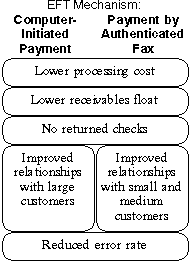
Payment by fax will be a significant factor in the foreseen increase in EFT penetration because it is attractive to small and medium businesses which would otherwise remain check based. Usually, this very segment of the business market accounts for the largest volume of items collected from businesses. There is little expense reduction in converting 80% of collection value to EFT if 80% of collection volume remains paper-based.
For large value receipts, EFT collection eliminates expensive courier service (a $100,000.00 payment delayed for 2 business days in the regular mail may cost up to $109.59 in interest expense at 10% interest rate). Irrespective of individual amounts, the aggregate amount of checks in the mail may be quite large. This "receivables float" reduction benefit may be shared with customers by extending payment terms by one or two days, or otherwise. Payment by fax is currently planned with small and medium value payments in mind (there is no set limit but $50,000.00 is used as a system design parameter).
Unlike a paper check deposited at the bank, an ACH credit transaction triggered by authenticated fax cannot be returned. From the payee's perspective this lowers the risk of doing business with a payor by fax. This and the other advantages of EFT collection improve the payee's relationship with small and medium business customers using payment by fax.
In processing payments, the payee must update its A/R system according to the remittance data sent by the payor with the payment. This implies a requirement for a payment advice to be sent to the payee. This payment advice may be received as a periodic statement, a fax transmission, or an electronic mail message. If the electronic mail message adheres to an industry standard format, it is called an EDI message. When EDI is used, automated A/R record updating can be automated and there is an immediate improvement in the A/R processing accuracy. This is one of the major incentives for using financial EDI.
It easy for banks to join a payment by fax program (see section 4.2.2). The payor's bank has to formally agree to participate in payment by fax and make the appropriate arrangements. The payee's bank need only to accept EFT transactions as an ACH receiving bank.
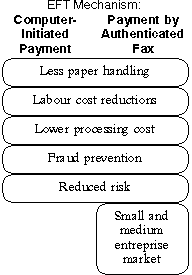
For banks, any EFT mechanism reduces the volume of paper checks to handle. This brings savings in labor and overall processing costs, as well.
Check fraud is a growing affliction for the U.S. check processing system. EFT payments are essentially immune to the type of fraud prevailing in the check system.
Fraud prevention is achieved by using information security technology, shortening the payment cycle, and reversing the direction of money flow. These payment process changes also reduce the financial risk borne by the banks (see note 5).
Banks would benefit from any significant expansion of EFT usage. In this respect, payment by fax is unique by its capacity to attract small and medium enterprises to EFT.
The U.S. payment system makes use of payment processors such as pay-by-telephone processors, ACH origination service providers, payroll processors, and lock box processors. All of these provide some type of interfacing between bank customers and the payment system, adding value and/or convenience to the basic payment services. Payment by fax is a service fitting naturally in the core business of existing payment processors (see section 4.2.1).
From the financial institutions' perspective, payment by fax may conveniently be outsourced to a payment processor, or it may be operated by the bank personnel. In the latter case, the benefits to the payment processor are those of the bank.
In the definition of new payment services, payment processors face many constraints. By accommodating any format for remittance data, payment by fax opens the door to an unrestricted payment service. This expands the potential market for payment by fax.
All electronic payment services require end-user support. For instance, most automated banking machines are equipped with a telephone receiver for 24 hour operator assistance. Computer initiated payment is the most support-intensive EFT mechanism. At the other end of the complexity spectrum, payment by fax is very easy to use. Payment request forms can be made self-explanatory, reducing the workload of the customer support function. Installation of payment by fax is trivial compared to installation of computer-initiated payment.
Both computer-initiated payment and payment by fax allow the payment of bills issued by large volume billers. Thus either or both of them may be marketed with the assistance of large volume billers. For the payment processor, the unit transaction cost of computer-initiated payment is less than the unit cost for payment by fax (the latter may require some operator intervention). On the other hand, payment by fax reaches a market segment that would otherwise remain check-based. Comparison of actual profit margins between the two payment mechanisms may not be made until price sensitivity data are supported by experience.
Payment by fax is differentiated from computer-initiated payment as a convenient mechanism to replace all checks issued on a checking account. Unlike bill payment services restricted to large volume billers and financial EDI restricted to EDI capable business partners, payment by fax is a horizontal payment mechanism. As such, it should find much attention from bank marketers.
Either with traditional paper check or payment by fax, the payment system is an involved process. Figures 2 and 3 show the payment process for traditional paper check and payment by fax respectively. Those already familiar with the U.S. payment system will appreciate the similarities between payment by fax and other EFT mechanisms.
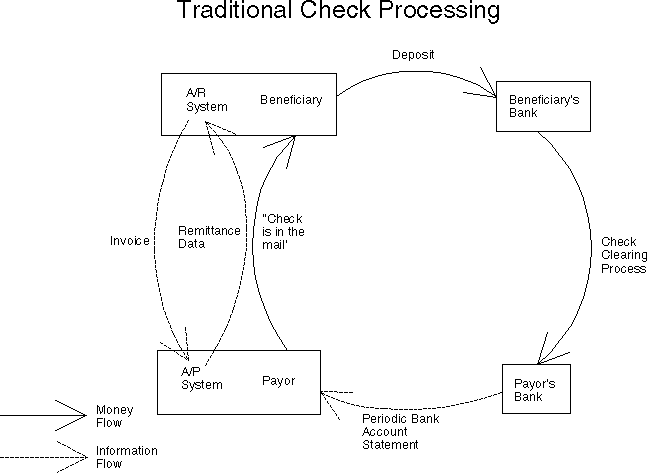
The proposed payment by fax processing makes use of the ACH payment network. This avoids unnecessary duplication of payment systems and will increase ACH processing usage. Since payment by fax is designed to replace all checks issued by a small or medium business, payment by fax must make up for current limitations of the ACH payment network.
One such ACH limitation is the uneven support of remittance data delivery to the payee. Payment by fax processing offers alternative remittance data delivery mechanisms. The payment by fax processors are well positioned to provide these alternative mechanisms without duplication of the core ACH functions. See also section 4.4.1 for further discussion of this topic.
Payment by authenticated fax transmission represents the advent of a new segment in the payment processing industry. As such, it involves equipment and system manufacturers, the banking industry, and bank customers. The supplier-customer relationships among these industry participants are illustrated in table 2. The roles of the payment by fax processor and the depository financial institutions are further explained in sections 4.2.1 and 4.2.2 respectively.
A payment by fax processor ("PbF processor") is an outsourcing organization or an operating department within a financial institution. A PbF processor is responsible for providing the payment service to payors who subscribe to the service.
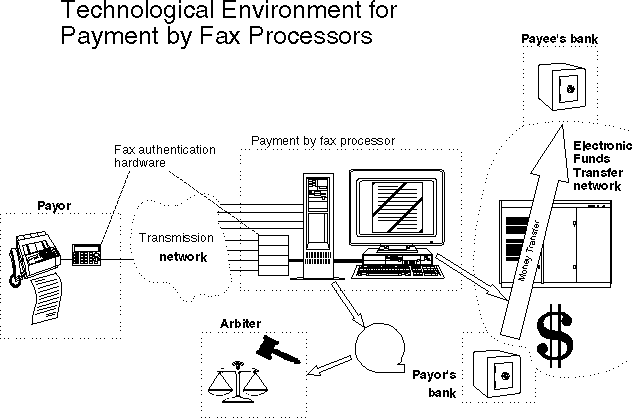
In the case of payment by fax, the PbF processor fulfills the following roles (from figure 4):
With the current payment process design, the PbF processor provides an interface between the payor and the payor's bank. Offering the payment by fax service for any payor's bank is conceivable but not currently considered.
The foremost task assigned to the processor is to turn the payment requests from their fax images format into a format suitable for the ACH network. The fax images are received directly in a computer system and processed by automated or operator-assisted methods. Compared with paper checks, the handling and labor cost of payment by fax are minimal: handling is fully electronic, and the operator tasks are limited to data entry and validation. Compared with computer-initiated payment, any operator intervention might be viewed as excessive.
Indeed, any operator-assisted process of payment by fax is reflected in added value to the payor (convenience of using existing business forms and additional transaction validation). With computer-initiated payment, the payor must himself convert existing business forms to a computer record. Payors must be trained to perform this conversion. Moreover, a computer-initiated payment transaction is never reviewed by a human operator after its initiation. Thus, the payor is solely liable for errors in the case of computer-initiated payment (see appendix A).
Transactions received from a payor by fax are first queued and later processed. In system design, queuing of transaction requests is an efficient load smoothing method. Queuing allows a system capacity planning based on average load. By contrast, the capacity requirement of a fully on-line system stems from the peak load. Thus the staffing requirements for payment by fax processing are reasonable.
A bank wishing to offer payment alternatives to its customers will make arrangements with a PbF processor to offer the payment by fax service as an option to business checking accounts. A participating bank must either be an ACH participant or agree to outsource the ACH origination function to a third party. Where the bank is a ACH participant, the PbF processing either may be integrated in the bank operations (as shown in figure 5) or outsourced to a third party (figure 6). When both the ACH origination function and the PbF processing are outsourced, figure 7 is applicable. Figures 5, 6, and 7 use the ACH credit transfer terminology where the payor's bank is an Originating Depository Financial Institution ("ODFI") and the payee's bank is a Receiving Depository Financial Institution ("RDFI").
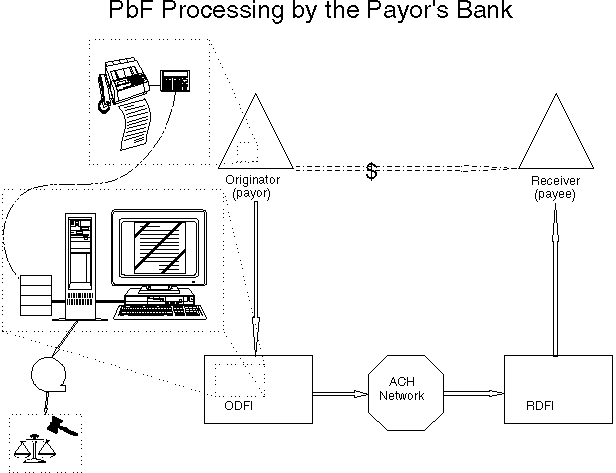
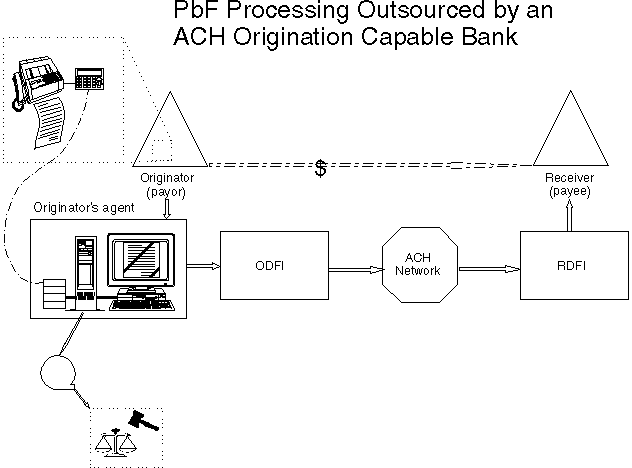
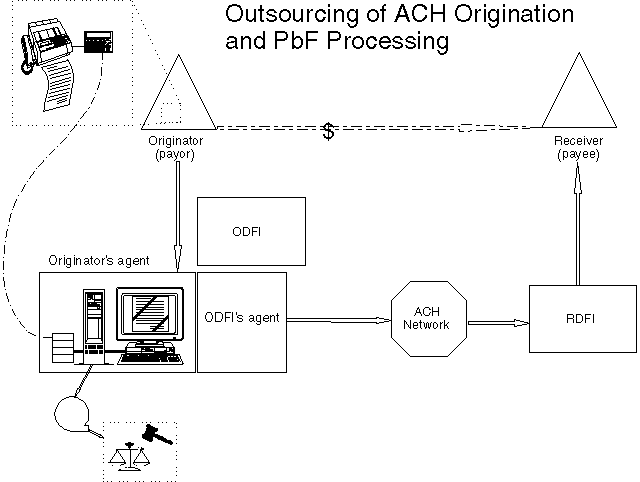
The participating bank is the payor's bank. The payee's bank need not participate in payment by fax. It is highly desirable for any U.S. bank to participate in the ACH payment network, at least as a receiving institution, for all ACH applications including payment by fax. Even payee banks not qualifying as an ACH receiving institution are supported by payment by fax. The only implication is the use of an atypical handling of transactions (see section 4.4.3).
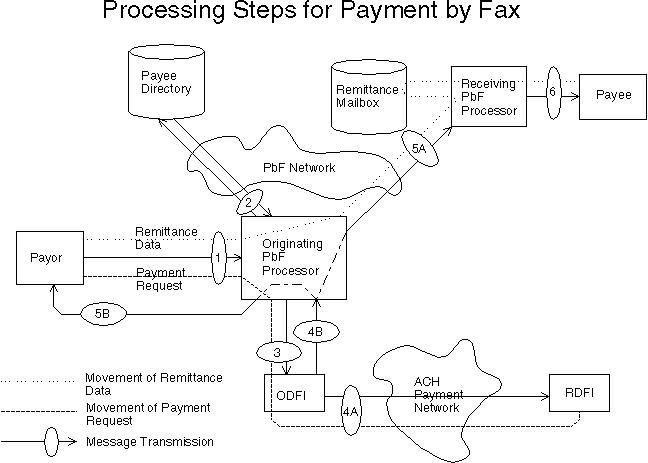
The processing of a sample payment is illustrated in figure 8. The processing steps are as follows:
Definition of a Payment Advice
A payment advice consists of:
1) a payment confirmation originating from the payor's bank, and
2) some form of remittance data originating from the payor.
A payment advice is directed to the payment beneficiary. For each payment received by a beneficiary, the remittance data format is either
3) a structured digital message, or
4) a bit map representing the partial contents of an unprocessed fax message (the bi-level bit map image of a remittance document).
Conversion from a structured message format into a bit map is a simple computer operation (like a printout of the structured message contents). The conversion in the other direction, from a bit map to a structured message, is a non-obvious process, most often requiring human operator intervention. Structured messages may be valuable to any beneficiary organization using or considering the use of any form of EDI, either by itself or through outsourcing. For this reason, payment advice methods that do not convert structured messages into bit maps have a greater potential value. Some payment advice method will accommodate only structured messages. Others accommodate either remittance data formats.
Timeliness of Payment Advices
Like check processing and ACH payment network, payment by fax is inherently a batch process. Individual payment advices are usually not needed. On the contrary, periodic batches of payment advices may best fit the beneficiary needs. For this reason, electronic or fax messaging mailboxes are needed to support the payment by fax process. In this specification, the term remittance mailbox is used to refer to the temporary storage of remittance data accumulated for a given payment beneficiary.
Table 3 gives the four elementary methods of delivering payment advices to a beneficiary.
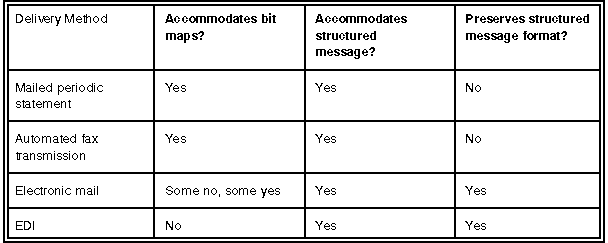
The selection of the ultimate delivery method from the above table to the beneficiary is a single component of a complete advice method specification. Another important component is the transmission network used between the payor (more precisely the PbF acting as the payor's agent) and the beneficiary. In the context of payment by fax, a beneficiary registers a preferred payment advice method with a PbF processor of its choice (see section 4.4.2 about this registration procedure).
A complete characterization of a payment advice method includes:
The following payment advice methods are supported:
With the next two methods, the originating PbF processor splits the payment transaction in two parts: the financial part and the remittance data. The financial part enters the ACH network as a CTX entry with a transaction reference number as the only payment detail data.
By default, the payment advice method is a remittance mailbox maintained by a PbF processor with facilities in the same geographical area as the beneficiary and periodical delivery of remittance data by fax.
When the preferred payment advice method does not support the bit map format, the beneficiary is requested to select a secondary payment advice method for the transmission of bit map remittance data. Since the secondary payment advice method should support the bit map format, some methods do not qualify as a secondary method.
A payment beneficiary registers itself with a PbF processor. In doing so, the beneficiary agrees to receive money directly in its bank account when the payment originated from payment by authenticated fax. The beneficiary need not be a payment by fax payor. This registration has many purposes:
Payors may request a beneficiary directory search to assist the preparation of payment requests. The information provided to the payor when a search is successful should include the beneficiary's name, address, and bank routing and account numbers, and other information as provided by the beneficiary upon registration. The requester receives more than one directory listing when the directory contains more than one matching entry. In any case, the payor is always responsible for the information contained in the payment requests (verifying the information directly with the beneficiary may be recommended).
The payment request has basically the same contents as a paper check, except that the beneficiary's bank routing number and the beneficiary's account number should be included if available to the payor. The payor has to include the bank routing and account numbers independently of the knowledge of the PbF processor of this same information. This is to make the payor liable for any error, yet it allows the PbF processor to reduce the likelihood of such errors. The validation is performed with very limited guarantee and with strict limitations of the PbF liabilities. The payor discipline of indicating bank routing and account numbers will facilitate later adoption of other EFT technologies (payment by fax is said to support evolution towards the paperless office).
The PbF processor is an agent of the payor and performs the following duties:
All PbF processors in the U.S. will be linked by a data communications network. This network is a wide area network (WAN), and may be a private network, a virtual private network, or simply access points to a public network.
This networking function serves the following purposes:
Since the PbF network is not directly involved in the payment transactions, it does not need to be protected by the strictest security procedures. Nonetheless some network security requirements apply to the PbF network. The following example threats should be kept in mind:
In all three examples, the functions devoted to the PbF network improves the overall security of the payment system. The PbF network must resist impersonation attacks. This can be achieved with access control and message authentication. The authenticity and integrity of beneficiary registration requests must be carefully checked, both at initial registration and subsequent updates or renewals.
Payment by authenticated fax transmission proposed by CONNOTECH may have a significant influence on the U.S. payment system. This document states the design principles for the required back office systems. It highlights the spread of liabilities for some EFT payment errors and shows how payment by fax attenuates the payment risk for all participants. This document also discusses the important issue of payment advice to the beneficiary.
Every payment method is subject to some forms of errors, inadvertently or deliberately introduced in the system. Errors may create liabilities that were not originally intended by the parties acting in good faith. As shown in the following discussion, the transition to EFT also changes the possible sources of errors, somehow shifting part of the payment risk from the beneficiary to the payor. Payment by fax is designed to minimize the consequences of the increased payment risk to the payor.
With paper checks, the payment advice occurs naturally as the beneficiary processes incoming mail and prepares a bank deposit. This is not the case with EFT where a payment advice is required, either as part of a periodic statement or as an isolated payment advice. Payment by fax is a unique EFT mechanism by virtue of being highly compatible with the contents of an envelope. In other words, since any remittance document can be sent by fax, payment by fax is the EFT mechanism that can replace all paper checks of a payor in the near term.
Simply stated, a business payment is the transfer of money from the payor's bank account to the beneficiary's bank account. Yet a business payment is not complete without a payment advice so that the purpose of the payment is fully known to the beneficiary. Translated into simplified information handling principles, there are two required transmissions:
Throughout the banking industry, processing efficiency is based on using bank and account numbers to identify beneficiaries, putting the beneficiary's name in the background.
With check payment, the entry point to the check clearing system is the beneficiary's bank where the check is deposited ("bank of first deposit"). The beneficiary's bank routing number and the beneficiary's account number are specified once for all deposited checks. This information is reliable because business beneficiaries will usually not attempt to deposit a check paying an unrelated party. Also payments are usually mailed to the proper address.
For the payor identification, the MICR line of each check provides the payor's bank routing number and the payor's account number with a negligible inadvertent error rate. However, check fraud caused by deliberate introduction of erroneous checks is a major issue in the U.S. payment system, with a total loss of $815 million in 1993 (American Banker Association, Check Fraud Survey Report 1994).
After the conversion to EFT credit transfers, the entry point to the payment network is the payor's bank when it receives the payment request from the payor. Then the payor's bank routing number and the payor's account number need not be questioned (at least in the case of payment by authenticated fax transmission). On the other hand, the beneficiary's identification is subject to errors.
Here are some facts about the beneficiary's identification in the context of EFT:
In this overall context, the challenge of increasing EFT credit transfer usage can be stated to include:
For the payor, here are the desirable features for payment by fax:
For the payee, here are the desirable features for payment by fax:
CONNOTECH Experts-conseils Inc.
9130 Place de Montgolfier
Montréal, Québec, Canada, H2M 2A1
Tél.: +1-514-385-5691
Fax: +1-514-385-5900